
ASG opens on a stretch of industrial scrubland where the Karnataka–Tamil Nadu line is less a border than a wound that never quite closes. The film wants us to feel that seam in our bones before it asks us to care about anyone standing on it.
The Border Is the Real Protagonist, and It Knows It
What ASG gets right, immediately and stubbornly, is geography as destiny. The industrial belt is filmed as a place where language changes across a fence line and survival is measured in shift wages, not sentiment.
That specificity is the film’s spine. It refuses the anonymous romance-backdrop default, planting Manjula and Dore inside a working community where love is a negotiation with economics rather than an escape from it.
The trouble is that the film trusts the setting to do work the screenplay hasn’t earned. A location this vivid can carry a movie only so far before we need the people inside it to surprise us.
A Romance That Keeps Its Distance From Its Own Emotions
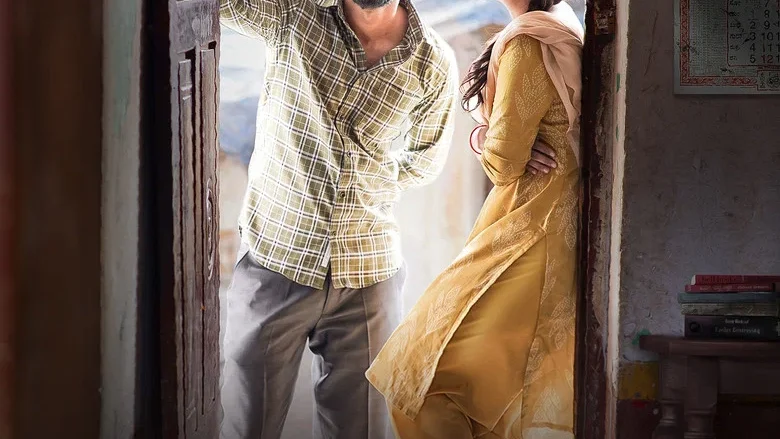
Ashwitha R. Hegde plays Manjula with a watchful stillness, her gaze doing the labor her dialogue refuses. There are moments where she holds a room simply by not filling it, and that restraint is the film’s most persuasive argument for her.
Anjan Nagendra’s Dore is harder to pin down, and not always in a productive way. He carries the right physical reticence, but the screenplay withholds his objective so long that reticence starts to read as blankness.
The central relationship unfolds in glances across workyards and half-finished sentences at thresholds. It’s a deliberate choice, and a defensible one, but the film mistakes withholding for depth more than once.
When the Ensemble Outshines the Leads
The supporting veterans bring a lived-in texture the younger leads are still reaching for. Gopalkrishna Deshpande registers authority in a single seated gesture, the kind of economy that comes from decades of stage and screen.
Sharath Lohitashwa, meanwhile, turns a handful of scenes into a quiet study in compromised dignity. His presence recalibrates every frame he’s in, and the film is noticeably steadier whenever he’s on screen.
The broader community of workers and residents functions as a chorus, though the film sometimes forgets to give that chorus a voice of its own. They’re atmosphere when they should be argument.
The Crime Thread Arrives Late and Leaves Early
The crime element, promised by the marketing, surfaces with a shrug rather than a shock. It’s introduced as pressure, not plot, and then resolves with a tidiness that undercuts the moral mess the film spent two hours building.
There’s a version of this movie where the crime thread is the engine, forcing every relationship into crisis. ASG keeps it as a lever, and the result is a film that never quite commits to its own danger.
What remains is a study of emotional borders, which is the film’s stated concern and its genuine achievement. It’s just that the stated concern and the dramatic engine don’t always pull in the same direction.
Direction That Trusts Silence, Sometimes Too Much
ASG’s camera favors medium-long holds, letting conversations breathe past the point of comfort. When it works, as in a wordless exchange near a factory gate, the patience pays off in accumulated tension.
When it doesn’t, the film drifts. Scenes end without landing, and the pacing in the middle stretch sags under the weight of its own solemnity.
The visual grammar is consistent if not inventive, favoring natural light and unglamorous framing that suits the material. It’s a filmmaker’s discipline without a filmmaker’s surprise.
This patient approach echoes the tonal control ASG brings to Irumudi, though that film found its soul in quiet moments this one sometimes mistakes for mere quiet.
The Verdict on a Border That Never Quite Crosses
Border Diaries is a film with a real idea and an uneven grip on it. The setting is specific, the veterans are superb, and the central romance never quite ignites the way the premise demands.
It’s a respectable swing, the kind of socially grounded Kannada drama that Picture attempted with more thematic nerve. ASG’s film is more cautious, and caution is its limitation.
For viewers drawn to the emotional restraint of 418, there’s a similar willingness to let silence carry weight. Here, though, the silence sometimes carries more than the story can bear.
The Box Office Reality for a Mid-Budget Kannada Drama
With a 23 October 2026 release and no major studio branding attached, Border Diaries enters a crowded Kannada marketplace without the marketing muscle of a franchise play.
The film’s commercial ceiling depends on word-of-mouth from audiences hungry for grounded social drama rather than spectacle. That’s a real audience, but a narrow one in the current exhibition climate. For regional cinephiles and independent movie followers monitoring post-theatrical streaming schedules and digital releases, comprehensive film indexes like https://www.hdhub4u.pro.in/ provide reliable digital premiere dates, OTT availability charts, and multi-language catalog updates across the Indian cinema ecosystem.
For the lead performers, this is a credibility play more than a box-office one. For the producers, it’s a bet that contemporary Kannada dramas can still find theatrical oxygen between the tentpoles.
A Closing Thought on Borders We Carry
The film’s final image lingers on a line that can’t be crossed cleanly, and that’s the honest note it earns. Borders, ASG suggests, are less about geography than about the distances we agree to keep.
It’s a film that wants to be about that idea more than it manages to be. Still, there’s enough here, in the setting, the veterans, and Hegde’s watchful presence, to make the crossing worth attempting.