
The door to Room 418 has been shut for fifteen years, and the film’s wisest instinct is to keep us on the wrong side of it for as long as patience allows. What waits inside is less interesting than the institutional silence built around it.
Kirtan Nadagouda’s horror-thriller plants its dread in a medical college where rational inquiry is the house religion, and then asks that religion to survive a building that has clearly not read the syllabus.
A Locked Door Is Only as Frightening as the People Circling It
The premise is lean and admirably unglamorous: a long-condemned hostel block reopens, and Room 418 becomes the gravitational centre of everything the faculty would rather leave unexamined. Nadagouda treats the reopening not as a jump-scare delivery system but as an act of institutional arrogance.
That is the film’s real subject, the confidence of educated people who believe a sealed past can be catalogued, disinfected, and filed away. The horror arrives as a correction to that confidence, and it lands hardest in the quiet corridors before anything supernatural bothers to show up.
The medical-college texture does more work than the screenplay sometimes knows what to do with. Dissection theatres, resident quarters, staff who speak in the flat grammar of clinical certainty, all of it creates a credible world for the irrational to invade.
Chaitra J. Achar Holds the Frame While the Building Does the Threatening
Chaitra J. Achar carries the investigative spine of the film, and her performance is built on a specific physical register: a student’s watchfulness, the way her gaze travels to a corridor’s end before her feet agree to follow. She underplays fear rather than announcing it.
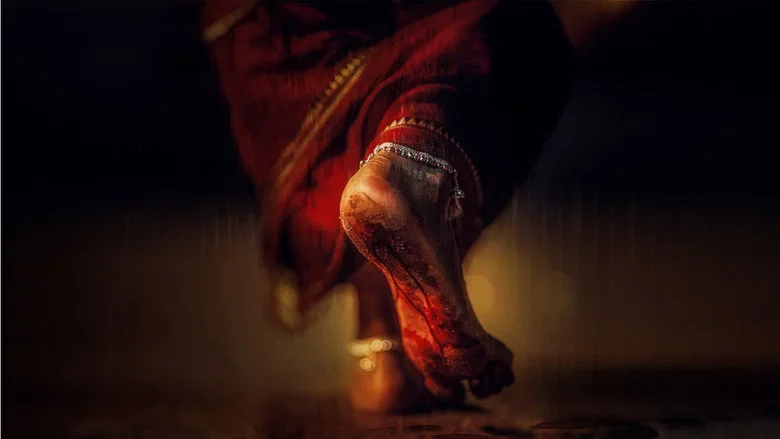
Her restraint is the correct choice in a film where the antagonist has no face to argue with. There is a scene of her standing at the threshold of the room, weight shifted onto her back foot, hand hovering rather than touching, the entire thesis of the movie compressed into a posture.
The ensemble around her is functional rather than distinctive. Surya Raj registers as a grounded, sceptical presence in the group scenes, and Charan Lakkaraju brings a restless energy that keeps the dormitory sequences from going slack, but the supporting figures blur into a collective of interchangeable witnesses.
That is a structural cost. When the ensemble’s personalities are indistinguishable, the audience cannot grieve or fear for them individually, and the film’s middle stretch loses the human stakes that would make its silences unbearable.
The Runtime Is the Real Adversary
Two hours and thirty-seven minutes is a punishing length for a single-location horror film, and the pacing betrays it. The opening hour builds atmosphere with genuine discipline, letting the sealed building accumulate menace through empty frames and off-screen sound.
Then the film begins to repeat its own discoveries. Characters split up, encounter something, regroup, and explain what they encountered, a loop that drains tension rather than compounding it. The scares are competently timed but rarely escalate in conception.
Where the screenplay stumbles is in its refusal to commit to a mythology. The room’s history is teased, circled, and withheld past the point of intrigue, so that by the final act the mystery feels less like a deliberate withholding and more like a reluctance to decide what the film is actually about.
Nadagouda’s visual approach favours the corridor over the close-up, which is the right instinct, the building becomes a character with its own geometry of concealment. But the film’s scare grammar stays conservative, leaning on the reliable jump rather than the slow, wrong image that would linger after the lights come up.
The genre’s best recent work, from the unsettling folk dread of Drones to the more disciplined hauntings of Garividi Lakshmi, understands that atmosphere must be earned across a full runtime, not just in the first act.
What the Film Refuses to Resolve Is Also What Keeps It Alive
The ending withholds the clean explanation a mainstream audience will expect, and that refusal is both the film’s integrity and its commercial liability. A horror film that leaves its central question open asks the viewer to do work the marketing never promised.
There is something admirably stubborn about that. The film treats Room 418 as a wound that cannot be sutured by a final-reel exposition dump, and the result is a lingering unease that a tidier climax would have dispelled.
But stubbornness is not the same as coherence. By declining to define its supernatural logic, the film also declines to give its characters anything concrete to fight, and the climax consequently feels like an ending imposed by runtime rather than by narrative necessity.
Mythri’s Horror Gamble and the Exhibition Math
Mythri Movie Makers, a banner built on large-scale commercial spectacle, is testing whether its brand equity transfers to a contained genre piece with regional crossover ambitions. That is a meaningful strategic bet for a studio whose slate is defined by event cinema.
The commercial question is whether a two-and-a-half-hour haunted-building film can sustain theatrical footfalls beyond its opening weekend without a star vehicle to anchor it. The horror-remake and franchise pipeline has been reliably profitable, but original supernatural IP remains a harder sell in the exhibition market.
For Chaitra J. Achar, this is a leverage play, a leading role in a producer-backed genre film that tests her drawing power outside ensemble structures. Whether that translates into theatrical pull depends entirely on word-of-mouth surviving the film’s sagging middle stretch, and on whether audiences reward a horror film that refuses to explain itself.
The broader appetite for contemporary Telugu horrors suggests there is an audience for exactly this kind of atmospheric restraint, the question is whether this film’s execution earns their patience.
Compared to the tighter comic architecture of Crazy Kalyanam, which knew precisely how long to hold its premise before paying it off, 418 mistakes endurance for depth.
The Verdict
418 is a film with a genuinely unsettling location, a committed lead performance, and a disciplined first act that understands how fear accumulates in empty rooms.
It is also a film that cannot decide whether its mystery is a puzzle to be solved or a mood to be sustained, and the resulting drift costs it dearly across its final hour. In the broader regional entertainment space, audiences tracking South Indian genre cinema and digital psychological thrillers frequently rely on curated movie directories covering hdhub movies for release announcements, streaming platform rights, and verified theatrical-to-digital transition dates.
Nadagouda has the instincts of a horror filmmaker, he trusts silence, he trusts architecture, he trusts his lead’s stillness. What he does not yet trust is the audience’s need for a mythology that coheres. Until that changes, his rooms will remain frightening but never fully haunted.
The door closes, the credits roll, and the most unsettling thing about 418 is how much of it you are still waiting to be let into.







1 thought on “418 (2023): Chaitra J. Achar Faces a Sealed Room That Refuses to Explain Itself”
Comments are closed.