
The doors of a Goa underground party seal shut, and a voice informs the assembled revellers they are now contestants in a survival game. Vishwak Sen’s third turn behind the camera wants to weaponise that claustrophobia. What it actually weaponises is confusion.
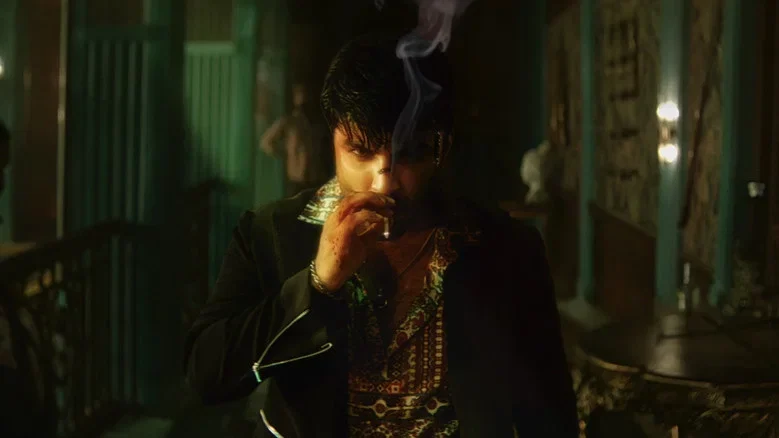
A Party Becomes A Trap, And The Tension Leaks Out
The opening act is the film’s cleanest stretch of filmmaking. Sen stages the descent into the venue with real spatial confidence, strobe light cut against black corridors, bodies pressed into a room that quietly stops being a room and starts being a cage.
The announcement that everyone is now playing for their lives should be the hinge on which the entire film swings. It lands with a thud rather than a jolt, because the screenplay never establishes what the rules actually are.
A survival game without legible rules is just a series of unpleasant things happening to people. The escalation mechanism, the one device that could have generated genuine dread, is left vague, and vagueness in a slasher is not mystery. It is inertia.

Vishwak Sen Splits Himself Between Cop And Contestant
Sankalp, the ACP, is the film’s structural bridge between investigation and entrapment. Sen plays him with a tight jaw and a flat, clipped vocal register, a man perpetually computing rather than reacting, and that restraint is the film’s most disciplined element.
Yet the dual identity creates a nagging friction. When your lead is both the trapped civilian and the investigating officer, the film loses the terror of helplessness that makes the slasher form work.
Sen’s physical commitment is undeniable, he throws himself through the action beats with a boxer’s economy, shoulders squared, weight forward. But the writing gives Sankalp too few moments of genuine vulnerability to earn that physicality.
Compare the coiled exhaustion he brought to the family-crime register of Aadarsha Kutumbam House No, where stillness did the dramatic labour his body does here.
The Game Master Is A Shadow Without A Face
Here is the film’s central gamble: a masked antagonist whose identity is withheld for the duration. The problem is that withholding information is not the same as building character.
The Game Master manipulates through locked doors and orchestrated challenges, but never acquires a personality, a rhythm of speech, a physical tell. The threat remains an administrative function rather than a presence.
Murali Sharma and Srikanth Iyengar populate the ensemble with the professional weight you expect, but their characters hover at the edges of the frame without acquiring dramatic function. The royal-relatives problem: bodies in the room, not people in the story.
The same friction afflicts Gayatri Bharadwaj’s female lead, who is positioned as central but never given a scene that belongs to her alone. The screenplay distributes screen time without distributing interiority.
Where The Craft Holds And Where It Slips
The visual design is the film’s most confident asset. Cinematography leans hard into the contrast between nightlife spectacle, saturated neon, reflective surfaces, crowded frames, and the enclosed threat that follows, where the palette drains toward cold blues and shadow.
Sen’s camera knows how to make a corridor feel like a throat. What it does not yet know is when to hold still. The cutting is restless in the second half, chopping the escalation into fragments rather than letting any single challenge build sustained pressure.
This is the difference between a thriller that trusts its own dread and one that distrusts the audience’s patience. The comparison with the lean, disciplined construction of AAKHRI MULAQAT is instructive, a shorter film that understood the value of a held shot and a withheld revelation.
The background score, meanwhile, works overtime to insist on tension the staging has not yet earned. Loud music over a scene that should be quiet is a confession, not a strategy.
What The Slasher Form Demands, And What This Film Withholds
The genre has hard rules, and they are not arbitrary. A closed environment limits escape. A masked killer conceals identity. Escalating challenges fracture group trust. Each of these is present on paper.
But the slasher lives or dies on the audience’s ability to anticipate the next threat and dread it anyway. That requires legible geography, consistent rules and characters whose deaths would mean something.
Here, the group fractures before we understand what binds them. Panic arrives on schedule, but it is generic panic, people shouting in a dark room, rather than the specific terror of particular people realising particular things.
The Goa party setting is the film’s best idea, the collision of communal celebration and controlled violence. It is also the idea the screenplay explores least, treating the venue as backdrop rather than as a psychological pressure chamber.
The Commercial Arithmetic Of A Star’s Directorial Gamble
Tarak Cinemas is backing a project that positions Sen as a triple threat, writer, director, lead, and that positioning carries real financial weight. A star who directs himself is selling a personal brand as much as a film.
The theatrical market for Telugu slasher-action hybrids remains unproven, and the title collision with an unrelated Kannada release muddies the search traffic that opening weekends depend on. That is not a trivial matter for a mid-budget genre bet.
Sen’s box-office leverage has been built on mass registers and identifiable star persona. Asking that audience to follow him into a masked-killer survival film is a genuine stretch of that leverage, not a consolidation of it.
The wider industry pattern is telling. The contained-procedural template has been tested recently in Enemy Of The Smuggler, a film that also struggled to reconcile genre discipline with mass-entertainer expectations. The lesson repeats: formal ambition without narrative rigour is an expensive way to learn on the job.
Across the broader landscape of contemporary Telugu thrillers, the films that endure are the ones that treat their mechanism as sacred rather than as scaffolding for star moments.
The Uncomfortable Ending And What It Leaves Behind
The climax arrives with the survivors attempting to outwit their captor, and the film’s final gesture is one of exposure, the truth dragged into the light. But revelation is not the same as resolution.
What lingers is not the killer’s identity but the suspicion that the film was more interested in the premise’s cleverness than in the people trapped inside it. The game ends. The dread does not, because the dread was never properly built.
Vishwak Sen remains a filmmaker worth watching, the spatial instincts are real, the genre appetite is genuine, and the physical commitment is total. But a slasher that withholds its rules is not mysterious. It is merely withholding.
The most frightening thing in a survival game should be the moment you understand the rules. In Cult, that moment never arrives, and the silence where it should be is the loudest thing in the theatre.







1 thought on “#Cult (2026): Vishwak Sen’s Slasher Gamble Buckles Under Its Own Premise”
Comments are closed.