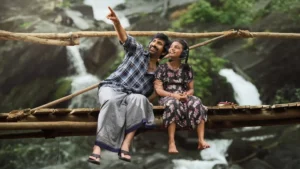
Krishna stands in Vrindavan, the memory of Radha’s separation cutting deeper than any mortal wound, as duty calls him toward the palaces and battlefields of a larger, colder world. Hardik Gajjar’s opening movement establishes this tension immediately, not through spectacle, but through the ache of what must be abandoned for what must be endured.
Krishnavataram Part 1: The Heart risks everything on the premise that Krishna’s greatest conflict is not mythological but emotional, played across multiple women and the impossible arithmetic of divine love. This is a bold wager in devotional cinema, one that delivers visual grandeur and sincere spiritual framing while stumbling under its own narrative weight.

Siddharth Gupta’s Krishna: Restraint as Spiritual Language
Siddharth Gupta refuses the baroque theatricality that often defines mythological leads. His Krishna moves from Vrindavan to Dwarka not through gestural transformation but through a deepening stillness, as if duty itself is a weight that compresses emotional expression into something more austere. In the film’s most effective passages, those early scenes anchoring Krishna to Radha’s absence, later moments navigating the marriage to Rukmini, Gupta locates divinity in emotional economy rather than display.
The performance holds strongest where the script anchors him to a single emotional current. When multiple relationship arcs splinter his focus, his restraint reads as distance rather than depth.
Gajjar’s Vision: Scale Wins, Momentum Fractures
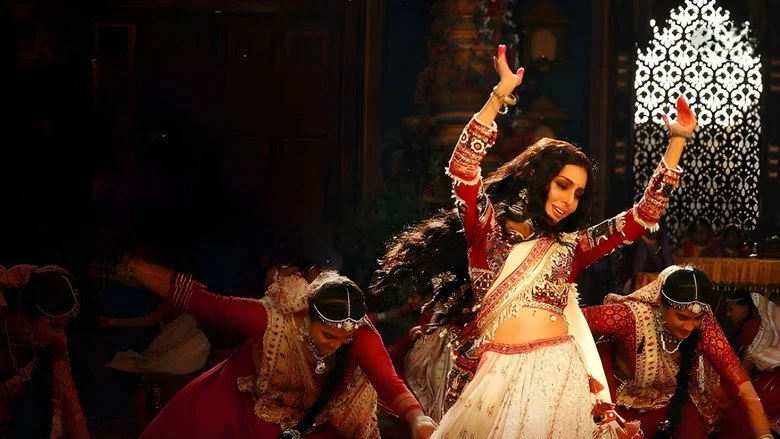
Gajjar clearly commands the visual grammar of mythological cinema. The Vrindavan-to-Dwarka passages unfold with temple-like richness and expansive landscape framing that genuinely supports the devotional tone. His structural choice to build the narrative around relationship conflict rather than miraculous intervention is intellectually sound and risks genuine emotional territory.
The screenplay’s fatal flaw is its refusal to choose. Four major emotional threads, Krishna-Radha separation, Krishna-Rukmini duty-marriage, Krishna-Satyabhama jealousy, Krishna-war responsibility, compress into one 150-minute feature. The middle section collapses under this weight, momentum fracturing into uneven pacing that neither crisis nor romance can repair.
Devotional Drama as Fractured Romance: Genre at War With Itself
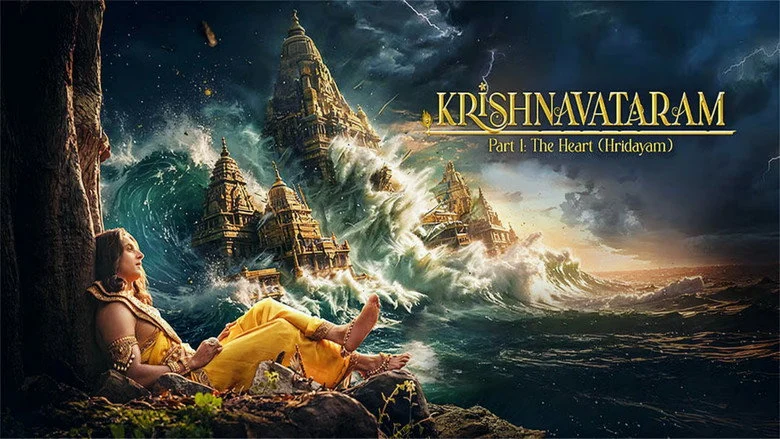
The film functions most coherently when framing Krishna’s journey as spiritual biography rather than dramatic escalation. The opening material anchors him to Vrindavan intimacy and Radha’s separation with genuine reverential weight. Here, the devotional intent clarifies the emotional spine.
Once the narrative expands to Dwarka and marriage, the film attempts to balance theology and relationship conflict across three women simultaneously. Rukmini represents duty, Satyabhama represents jealousy and devotion, Radha represents the spiritual past. The architecture is sound in theory, multiple relational lenses showing different facets of Krishna’s divine identity. In execution, these threads compete rather than interweave, each demanding emotional real estate the film cannot consistently provide.
The Kurukshetra material compounds this tension by subordinating war and political conflict to the romantic-devotional arcs. A mythological film that treats the Mahabharata as secondary landscape rather than central catastrophe is philosophically defensible. It is also dramatically precarious when the romance preceding it already strains the narrative.
Sanskruti Jayana and the Question of Satyabhama’s Jealousy
Sanskruti Jayana carries the principal emotional counterweight in the relationship architecture. Her Satyabhama gains force through the dynamics of jealousy and devotion, a role that could dissolve into resentment or deepen into spiritual complexity. Jayana’s work suggests the latter intention, though the screenplay doesn’t quite afford her the space to sustain it across 150 minutes of competing narratives.
Sushmitha Bhat’s Radha anchors the separation track that motivates the entire first part’s emotional premise, while Nivaashiyni Krishnan’s Rukmini complicates the balance by embodying duty and marriage obligation. Both are cast for thematic clarity, to show Krishna through relational prisms, yet neither receives the character development necessary to make their scenes feel like earned dramatic progression rather than obligatory plot stations.
Devotional and mythological films that feature strong ensemble casts often succeed by allowing supporting characters mythic weight equal to their narrative function. Krishnavataram Part 1 positions its women as emotional mirrors rather than independent dramatic forces, a choice that limits their capacity to surprise or deepen the material.
A Trilogy’s Opening Gambit: Ambition Without Complete Payoff
The film’s decision to position itself as part one of a larger arc is both its most interesting risk and its most frustrating structural choice. Rather than seeking closure, it frames the Kurukshetra phase as merely the opening chapter of Krishna’s spiritual journey, leaving the mythology deliberately unresolved. This is philosophically coherent, Krishna’s story is infinite, his duty never concludes, yet it leaves audiences without the dramatic or emotional resolution that typically justifies a 150-minute investment.
For viewers seeking devotional spectacle and mythological scope, the visual presentation and sincere spiritual framing deliver. For those expecting tighter narrative control or deeper character work, the diffusion across multiple emotional tracks and uneven pacing prove taxing. I found myself respecting Gajjar’s theological ambition more than the film’s actual emotional execution.
Watch this in regular theatrical format if you’re drawn to devotional cinema or relationship-led spiritual narratives. The visual scale demands a larger screen, yet the core argument about love and duty would translate adequately to streaming platforms. Skip if you prefer mythology delivered with either sharper dramatic economy or more generous action spectacle.
Krishnavataram Part 1: The Heart reaches for something genuinely different in devotional cinema but fractures under narrative weight, a 3 out of 5 that hints at what a tighter edit or more selective emotional focus might have achieved.
For other examinations of ambitious mythological storytelling across languages, Hindi Primary Devotional reviews and their craft choices reward deeper critical attention.
Similar ambition in biographical framing appears in Star Wars review, where restraint and scale must coexist.
The tension between emotional restraint and narrative scope also defines Michael verdict in mythological cinema.