Shivaji stares across a bloodied battlefield, the weight of empire-building pressing down before a single sword strike lands. Raja Shivaji arrives as a 3-hour-plus historical epic that stakes everything on its lead actor’s ability to carry the burden of founding a nation, a gamble that early responses suggest pays off, though the film’s ambition frequently outpaces its execution.
Riteish Deshmukh directs himself into what critics are calling a career-best performance, moving beyond his comedy roots into the political and military stratosphere of a historical biopic. The gamble is not subtle: position one mainstream Hindi actor as Chhatrapati Shivaji Maharaj across six language markets, then ask audiences to sit through a three-hour foundation myth. It’s the kind of swing that either establishes a performer’s range or exposes the limits of casting comfort.
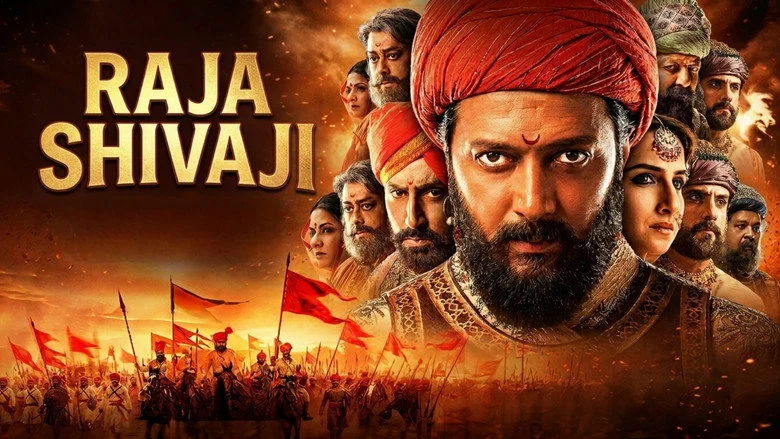
Riteish Deshmukh Carries the Coronation on His Shoulders
Deshmukh’s turn as Shivaji has drawn consistent praise from early viewers and industry observers, with Times of India’s social media coverage noting that “netizens call it Riteish Deshmukh’s career-best.” His performance anchors the film’s entire three-hour arc, from a young man resisting oppressive powers through the political consolidation and military strategies that ultimately lead to his crowning as Chhatrapati monarch.
What works is restraint. Rather than playing Shivaji as a rousing action hero, Deshmukh inhabits him as a strategist under pressure, a leader learning to navigate betrayal and battlefield mathematics simultaneously. The role demands range across quiet council scenes and explosive confrontations, and by most accounts, he delivers both.
Direction and Screenplay Stretch Ambition Across Six Languages
Deshmukh’s directorial approach is built around scale: grand battles, emotional weight, breathtaking visuals framing the founding of Hindavi Swarajya. The multilingual release strategy, Hindi, Marathi, Telugu, Tamil, Kannada, Malayalam, signals confidence that this story transcends regional cinema into pan-Indian historical property.
The screenplay structure follows a linear historical progression, moving from Shivaji’s early defiance through strategy sequences, betrayals, and battlefield confrontations toward the climactic coronation. What remains unclear from available evidence is whether three hours of political setup and military consolidation maintains audience investment or tests patience.
Historical War Drama Hinges on Afzal Khan and Coronation Beats
The Afzal Khan confrontation sequence emerges as the film’s standout action-historical anchor. This is where the genre machinery, war staging, choreography, historical authenticity, converges around Sanjay Dutt’s antagonist performance. Early audience reactions repeatedly flagged this sequence as the film’s emotional and technical peak, a moment where historical drama and action execution align.
The coronation sequence itself functions as the narrative culmination, the culmination of Shivaji’s rise from resisting tyranny to founding a nation. It’s positioned as the historical payoff rather than a surprise twist, which means the entire middle section must justify its journey. How effectively the screenplay executes that slow-burn ascent determines whether viewers experience revelation or repetition.
Ajay-Atul’s music emerges as a consistent strength across critical and audience response. The score and song work are positioned as core contributors to the film’s emotional impact, supporting the battles, the political intrigue, and the coronation with musical weight. This becomes crucial in a 186-minute film where audio-visual pacing can either propel or stall narrative momentum.
Other strong historical dramas worth exploring: Marathi Historical reviews continue to surface ambitious biographical projects testing actor and director range.
Sanjay Dutt and Abhishek Bachchan Anchor the Supporting Hierarchy
Sanjay Dutt as Afzal Khan carries the antagonist weight with a performance that early reactions singled out for praise. His role as Shivaji’s primary obstacle grounds the conflict in personal and political stakes. Dutt’s presence signals the film’s investment in casting performers who can match Deshmukh’s intensity, not merely support it.
Abhishek Bachchan, cast as Sambhaji Shahaji Bhonsale, positions himself as a secondary power center within the narrative hierarchy. Early audience feedback included praise for his performance, though specific scene-work details remain unavailable. His casting suggests the film treats its supporting roles as dramatic anchors rather than decorative positions.
A Historical Epic Betting on Mainstream Acceptance
The film’s scale and multilingual release strategy are calculated bets that Indian audiences will embrace a Bollywood-led historical epic in their regional languages. This is less about controversy and more about audience reception risk: whether a 186-minute biopic can sustain interest across dramatic pacing and battle sequences without the emotional melodrama typical of Hindi period pieces.
If Raja Shivaji connects, it redefines what mainstream Hindi cinema can attempt with historical material. If it doesn’t, the blame lands squarely on whether ambition exceeded execution, whether three hours genuinely served the story or simply indulged it.
This is a film worth watching if you’re prepared for deliberate pacing and political storytelling over action spectacle. The performances, particularly Deshmukh’s, suggest artistic growth. Ajay-Atul’s music lifts the material. But the runtime demands patience, and early evidence suggests the film tests that patience knowingly. Watch it in Hindi or Marathi to fully absorb the historical framing, the multilingual release means no version is definitive, but the source language often carries the strongest emotional resonance in period work.
Raja Shivaji is an ambitious historical swing that lands most of its performances and music but asks viewers to trust ambition over proven narrative efficiency, a solid 3 out of 5 that rewards patient audiences and potentially frustrates those expecting tighter biopic conventions.
The same deliberate pacing and historical reverence appear in Ek Din review, where character building occasionally outweighs momentum.
Both films share a director’s willingness to sacrifice efficiency for emotional depth in Krishnavataram Part verdict, though with markedly different results.