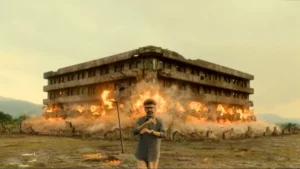
The planet is barren for the first stretch of Taxila. Then it isn’t. Sathish Ramakrishnan, wearing both the director’s cap and the lead role of Vikram, stages the awakening not as a triumphant crescendo but as something slower and stranger, dust giving way to something that looks almost like intention. It’s the single most arresting idea in the film, and it arrives early. What follows is a hundred minutes of a movie trying, and largely failing, to live up to the image it just conjured.

An Ambitious Premise, Suspended In Orbit
The setup is genuinely unusual for Tamil cinema: Earth is destroyed, its fragments and encoded legacy scattered across the cosmos, and a distant world called Taxila begins to stir as those remnants seed new life. That’s a legitimately exciting launch point, part Interstellar, part speculative myth-making, with faith and indigenous cultural resilience folded into the rebuilding. The film’s utopian sci-fi framing gives it a distinct identity, and you can feel Ramakrishnan reaching for something bigger than the standard commercial template.
The problem is that the reach exceeds the grip. As Cinema Express put it, the “intriguing setting doesn’t pay off in most parts”, and that single line is the most damning thing you can say about a concept-driven film. The world is built. The world is not inhabited.
Where The Vision Holds, And Where It Slips
Watch the seeding sequence closely. The planet’s transformation is handled with a certain restraint, no bombast, no swelling orchestral cue telling you to feel awe. It’s a smart choice, and it briefly suggests a filmmaker more interested in texture than spectacle. But that same restraint becomes a liability in the middle stretch, where the narrative around Vikram and the survivors should be tightening into conflict and instead drifts. The thematic ambition, faith, rebellion, identity, is all stated, rarely dramatized.
Ramakrishnan the actor is serviceable as Vikram, but Ramakrishnan the director never gives Ramakrishnan the actor a scene with real teeth. S.S. Raman as Rama and Alagumuthu as Alagu are present without being given much to do, and there’s no clearly defined antagonist to push against, which means the film’s central struggle stays abstract when it needs a face. For a story about rebuilding civilization, we never quite feel the weight of what’s been lost.
If you want a recent example of a high-concept Tamil premise that at least commits to its own momentum, our review of Dark Heaven review makes for a useful counterpoint, that film, whatever its flaws, keeps its engine running. Taxila idles.
The Craft Question: Ideas Without Consequence
There’s no denying the production is trying. The barren-planet imagery has weight, the cosmic-remnant mythology is thoughtfully assembled, and the decision to frame humanity’s end as a new beginning is thematically rich on paper. But paper is where much of it stays. The editing never finds a rhythm that could mask the screenplay’s thinness, and the film’s refusal to isolate a single, memorable set piece means nothing lodges in the memory the way the opening image does.
This is the recurring trap of ambition without architecture, and it’s the same reason our review of Biker verdict flagged a promising lead performance that couldn’t rescue a stalling structure. Strong anchors, weak spines.
Verdict: A Concept In Search Of A Film
Taxila is the kind of movie you want to champion, original, thematically restless, unwilling to be just another mass-market offering. But wanting to champion something isn’t the same as being able to. The premise deserves a sharper script, a clearer antagonist, and a director willing to trust his own lead performance. As it stands, the film is a beautiful first act wrapped around a body that never quite comes alive.
See it if you’re a devoted sci-fi completist curious about where Tamil speculative cinema is heading. Skip it if you need your ideas to land. As we frequently examine across Tamil Sci Fi reviews, ambition is only the beginning of the job.
Rating: 2.5/5