
Bhushan’s Manduka opens on the most fragile premise in the crime-thriller playbook: a schizophrenic girl stumbles into the orbit of four criminals, and the police give chase.
What follows is a hundred-and-four-minute hide-and-seek that mistakes narrative withholding for suspense.

A Vulnerable Protagonist Stranded Inside A Four-Headed Villain Problem
The film’s structural gamble is the accidental encounter, a collision that should ignite paranoia but instead merely initiates pursuit.
Four criminals, Bhushan himself among them, alongside Mysore Raju and Manikanta, create a diffuse threat with no single gravitational center.
Where a tighter thriller would let one antagonist dominate the frame, Manduka spreads menace across a committee, and the tension thins accordingly.
Just as the fragmented identity gambit in KillR buckled under too many competing perspectives, this film’s multi-villain architecture dissipates the very dread it hopes to manufacture.
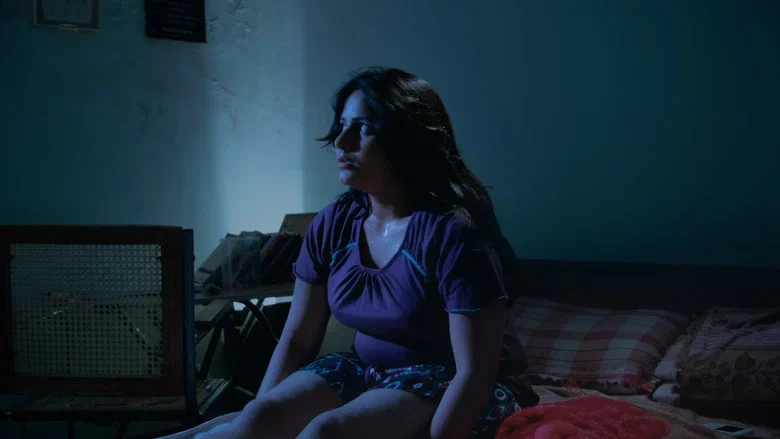
Anjala’s Illness Becomes A Plot Device, Not A Performance
Anjala is handed the film’s heaviest burden, a protagonist whose perception cannot be trusted, yet the screenplay gives her no scene to anchor that instability.
Schizophrenia here functions as a narrative convenience, a way to introduce doubt without dramatizing the lived terror of a mind at war with itself.
The performance foil is instructive: the slasher theatrics of #Cult at least committed to a physical register, whereas Manduka asks its lead to carry psychological weight the script never earns.

The Stillness That Should Manufacture Pressure Never Arrives
Bhushan’s direction favors the procedural chase, police moving through corridors, criminals regrouping, but the camera rarely lingers on a face long enough to register fear.
Manjunath Mirle’s police role exists almost entirely as a functional presence, a uniform that advances pursuit without acquiring a personality.
When the film does pause, it is to explain rather than to observe, and the explanatory beats flatten what should be the thriller’s most volatile moments.
A Compact Runtime That Feels Longer Than Its Minutes
At a hundred and four minutes, Manduka should move with the clipped efficiency of a true-crime dispatch.
Instead, the middle section sags under the weight of a hide-and-seek framework that repeats its own geometry, search, conceal, repeat, without escalating the stakes.
The thematic sibling Tadviruddha at least used its structure to interrogate memory and time; this film uses its structure merely to delay the inevitable confrontation.
Bhushan Wears Three Hats And None Of Them Fit Comfortably
Credited as director, writer, and villain, Bhushan exerts total authorship over Manduka, and the result suggests a filmmaker too close to his own material to see its gaps.
His villain turn lacks the spatial menace that a single, dominant antagonist could provide, and his screenplay never resolves the central mystery with the clarity a paying audience deserves.
The film’s refusal to commit to a satisfying resolution reads less like ambiguity and more like indecision.
A Regional Thriller Pipeline That Needs Sharper Instincts
For the producers backing this release, the commercial math is unforgiving: a modest Kannada crime thriller without a marquee star or a distinctive directorial signature struggles to break out of its home market.
The broader contemporary Kannada thrillers landscape has shown appetite for tight, character-driven crime stories, but Manduka arrives without the word-of-mouth engine such a release requires.
Its theatrical lifecycle will likely be brief, and its afterlife on streaming will depend on whether audiences discover a film the marketing has struggled to define.
The Uncomfortable Verdict: A Premise With Potential, A Film Without Pulse
Manduka wants to be a psychological crime thriller about the instability of perception, but it settles for a chase movie that never quite catches anything.
Anjala is stranded by a script that treats her character’s illness as a plot mechanism rather than a human condition, and Bhushan’s triple duty leaves the film without the outside eye it desperately needs.
What lingers is not the mystery but the frustration, a compact runtime, a promising premise, and a director who could not see the film he was actually making.







1 thought on “Manduka (2026): Bhushan’s Schizophrenia Thriller Collapses Under Its Own Conceit”
Comments are closed.